Introduction
The North Carolina State Constitution requires the General Assembly to provide funding for “a general and uniform system of free public schools,” but it also allows the legislature to delegate additional responsibility to local governments. The legislature may “assign to units of local government such responsibility for the financial support of the free public schools as it may deem appropriate.
That provision means that local units of government may add to or supplement any public school or postsecondary school program. The North Carolina Supreme Court has interpreted it to mean that the state must provide citizens with “access to a sound basic education” but that the legislature may delegate some funding responsibility for schools to local governments, which may provide funds at or above what is required by the state legislature.
Further definition of how the public schools are funded can be found in the North Carolina General Statutes. G.S. § 115C-408 makes it state policy “to provide from State revenue sources the instructional expenses for current operations of the public school system as defined in the standard course of study” and make sure “that the facilities requirements of a public education system will be met by county governments.
While putting forth which education expenses are to be met by the state and which by the counties, the law does not assign any specific funding responsibilities. Rather, it lays out the goals or desires of the legislature, but the matter has become less clear over time. State government is charged with providing for instructional expenses, and local governments are responsible for capital funding, but in recent years, the state has provided more funding to local districts for capital costs via a variety of programs.
Funding for capital projects is administered through the North Carolina Department of Public Instruction (NC DPI). The goal of these efforts is to assist county governments in meeting their public-school building needs. Currently three types of capital funding are available through the NC DPI, and all three are funded by the North Carolina Education Lottery: the Public School Building Capital Fund, the Public School Building Repair and Renovation Fund, and the Needs-Based Public School Capital Fund.
According to state law, county commissions have the primary responsibility to fund school district facilities at the local level.
As part of their joint responsibility, local government officials collaborate with boards of education to oversee the funding, construction, renovation, and maintenance of school district facilities. In most cases, county commissions and local boards of education accept discrete responsibilities for school facilities. School districts manage the school facilities program, while county commissions finance it. County commissions may allow local boards of education to build schools on property owned by
the county. Commissions also have the power to acquire property on behalf of a board of education and construct, equip, expand, improve, or renovate a property for use by a local school system.
To fund school facility projects, county commissioners approve debt financing in the form of certificates of participation and installment purchase contracts (neither of which require voter approval) or general obligation bonds (which do require voter approval). The state also permits local governments to impose local option sales taxes and other supplementary taxes to pay for school facilities.
Considering the importance of school facilities and the expenses involved in building and maintaining them, county commissions and school boards must be committed to spending capital dollars wisely, utilizing efficient building practices, and adopting innovative solutions to ensure that all children have an adequate and efficient learning environment.
Key Facts
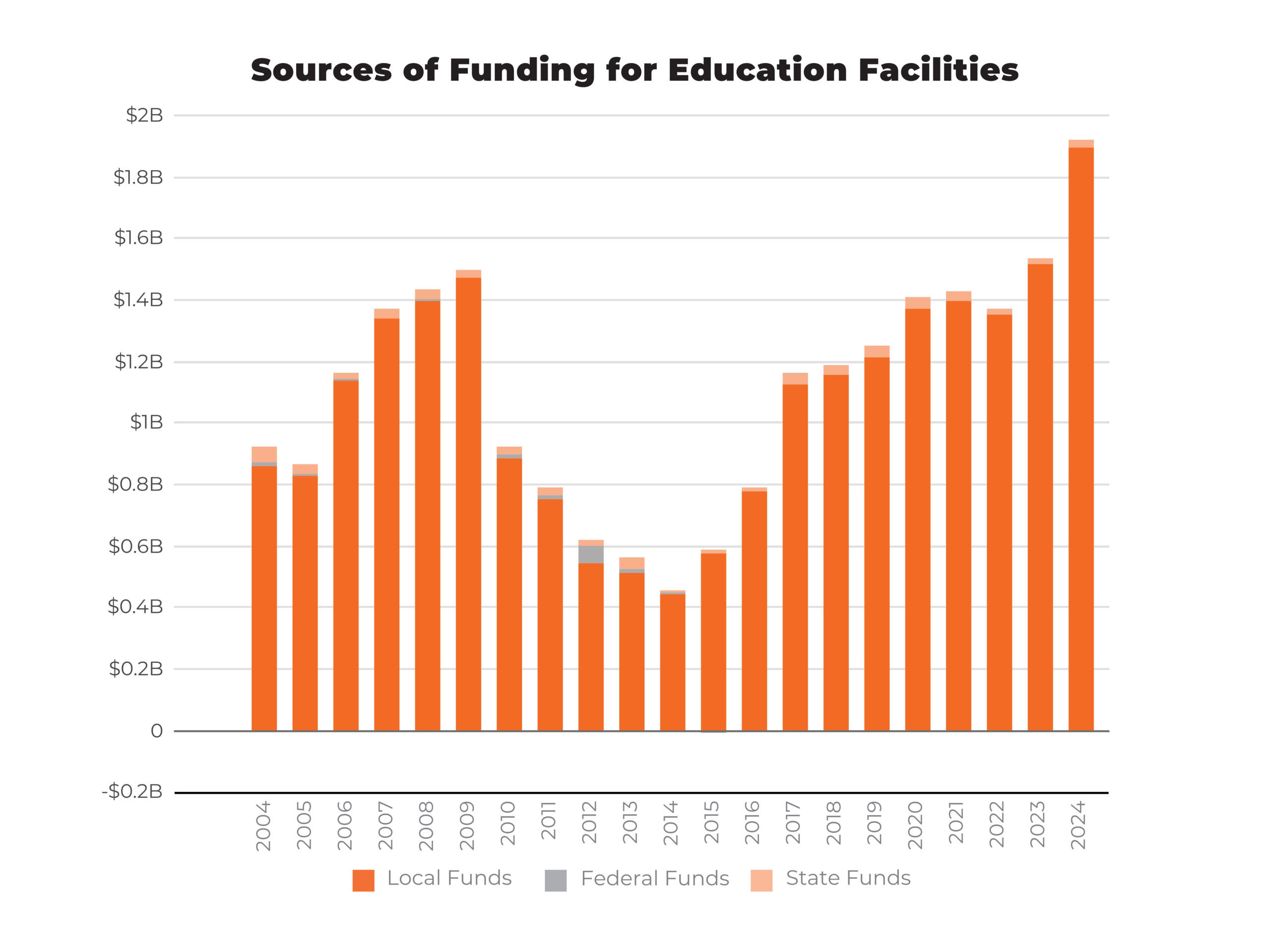
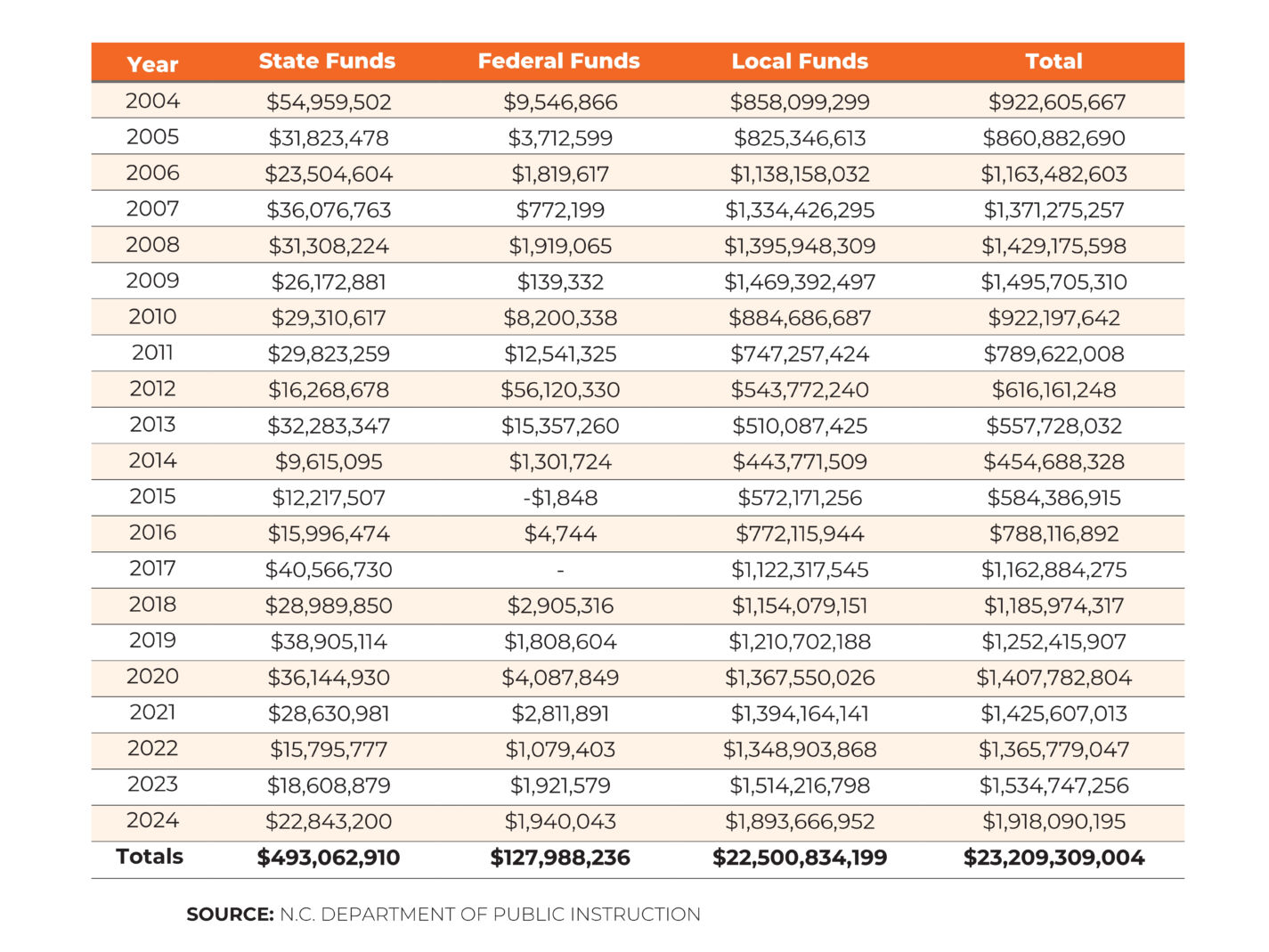
- Since 2000, North Carolina local governments have spent over $22.5 billion on school facilities, averaging nearly $1.1 billion a year. Locally funded capital expenditures represent almost 97 percent of all public-school capital spending in the state. In 2023–24, state, local, and federal government sources spent more than $1.9 billion on capital facilities in North Carolina, and local taxpayers were responsible for all but $25 million of that.
- The state legislature infrequently provides state funds for school facilities. Since 1949, the General Assembly has passed only one appropriation bill for facilities and five state school bonds. The legislature approved the last statewide facilities bond in 1996. Since 2004, the state has provided local schools with over $493 million in funds for school facilities.
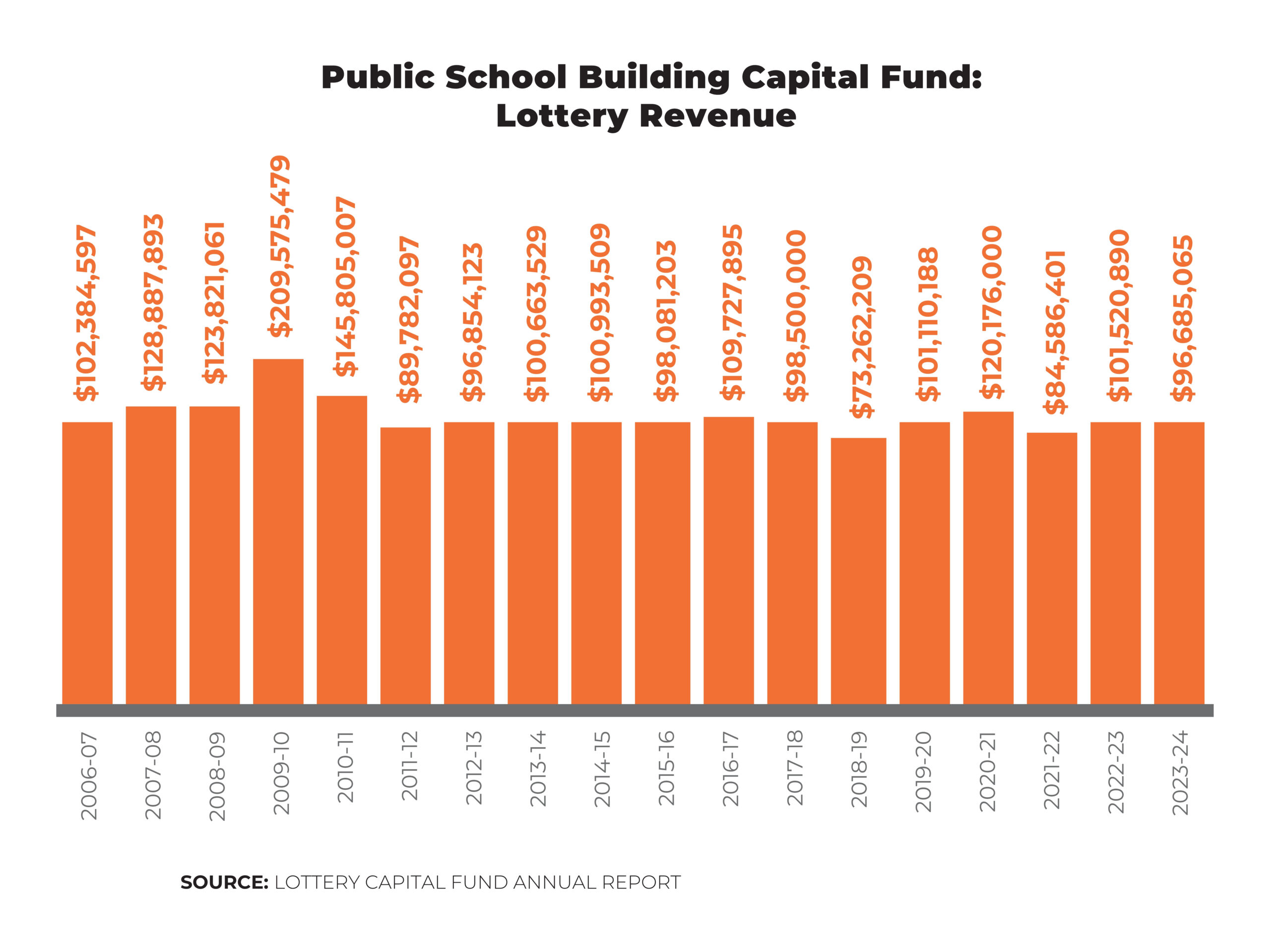
- State funding for local school districts is usually distributed via the Public-School Building Capital Fund, which has two funding sources: local option sales taxes and state lottery revenues. All counties levy two half-cent additions to the state sales tax, and 30 percent and 60 percent of the revenue, respectively, goes to schools. Counties may also levy either an additional quarter-cent sales tax or a land transfer tax for funding school facilities.
- Currently about $100 million in lottery revenue is distributed to the Public-School Building Capital Fund each year.
- In 2017, the North Carolina General Assembly established the Needs-Based Public School Capital Fund, which allocates North Carolina Education Lottery funds for new school construction in low-wealth counties (Tier 1 and Tier 2 counties in the North Carolina Department of Commerce’s ranking of counties by economic distress). The fund has awarded nearly $1.6 billion to local school districts for new and replacement schools.
- In 2025 the General Assembly passed disaster recovery legislation allocating $56.3 million in interest earned from the Needs-Based Public School Capital Fund for rebuilding public schools in areas damaged by Hurricane Helene. The bill allocated another $8 million to DPI for competitive grants for repairing school infrastructure damaged by Helene, setting the maximum grant award at $500,000.
- Public charter schools do not receive capital funding from the state. Charters must use a portion of their operating funds to cover the cost of leasing a facility or repaying capital debt incurred through a private or nonprofit lender. In 2023, legislation was passed to allow local counties — if they so choose — to contribute local tax revenue to help charter schools fund building needs.
Recommendations
1. Have local governments minimize the amount of debt incurred for school capital expenses.
Weigh a short-term need for additional classroom space or building repair against the fiscal implications of assuming long-term capital debt. Make sure when planning for these obligations to include a thorough examination of current and projected revenue streams, student enrollment, population, and the county’s financial obligations. Use this information to determine whether the county’s tax base will support years of debt service payments, and if need be, consider deferring the project under consideration or building up a reserve fund.
2. Have local governments encourage school districts to use proven, cost-efficient building solutions that would not burden county taxpayers and free up more money for educating students.
Every year, county commissions dedicate millions of local taxpayer dollars for debt service to maintain unnecessarily costly school construction programs. Public/private partnerships, adaptive reuse buildings, ninth-grade centers, satellite campuses, and virtual schools allow school districts to increase school capacity faster and more cheaply than conventional school construction and renovation methods. When districts spend too much on capital costs, it takes away funding that could be used more directly on educating students.
3. Revamp How School Construction Needs Are Assessed.
By law, local school boards must submit long-range plans to the State Board of Education every five years. Currently North Carolina public schools have $12.7 billion in planned new construction, additions, and renovations. Given the increased interest and growth in charter, private, and home schools, as well as demographic changes and an increasingly competitive environment for public investment, North Carolina should reevaluate its Five-Year K–12 Facility Needs Report. More frequent assessments of facility needs would ensure timely, reliable recommendations and estimates that are cost-effective and responsive to public needs.
4. Bring more equality in financing charter schools and other educational options.
Even though North Carolina law speaks to how state appropriations for local public and charter schools are meant to be equal, disparities exist. Schools need greater clarity on what funds can and cannot be used and what funds must be shared between public and charter schools.
5. Find a more dependable source of revenue for local capital costs.
Today, lottery funds comprise a major source of capital funding for schools for buildings, repairs, and renovations. Money available from the lottery is subject to great variability, however, from the number of players to especially the percentage lawmakers choose to allocate to various school needs. Policymakers should seek to tie capital funding to a more reliable source of funding.