Introduction
Article I, Section 4 of the United States Constitution gives state legislatures the primary responsibility for choosing the “Times, Places and Manner of holding Elections for Senators and Representatives.” That means state governments are responsible for setting most election laws and regulations.
In North Carolina, county boards of elections are responsible for registering voters, running elections, and counting ballots. They also secure locations for election day polling places and early voting sites. The
North Carolina State Board of Elections (SBE) sets policies for the county election boards and provides guidance on election administration issues based on election laws.
County boards of elections maintain lists of registered voters and report any changes to their lists to the SBE. They regularly update those lists by adding new registrants and removing registrants who have died, been convicted of a felony, or moved out of the county. The SBE provides data, such as death records, to county boards to help update registration lists.
Many registrants, however, do not inform election boards when they move out of a county, meaning that lists become less accurate over time. To fix that problem, county boards perform biennial list maintenance by removing registrations under two criteria: the registrant has not voted in any election in the county over four federal election cycles (eight years) and has not replied to a contact from the county board.
List maintenance is effective only if election boards have accurate data on people no longer eligible to vote. The Electronic Registration Information Center (ERIC) shares death and new voter registration data between member states. It also allows member states to share purchased data, such as the U.S. Social Security Administration’s death index. However, there are concerns that the ERIC data-sharing process would violate the privacy of those who choose not to register to vote. Because of those concerns, the fiscal year (FY) 2023–24 state budget included a provision barring the state from joining ERIC.
The SBE also conducts post-election audits and oversees sample hand-to-eye recounts by county election boards. A growing number of states have adopted procedural, or performance, audits. More than simply recounting ballots, performance election audits assess the trustworthiness of the paper trail as a record of legal voter intent, such as voter registration records and ballot chain-of-custody. Independent or outside bodies can conduct performance audits to remove the inherent conflict of interest involved with election bodies auditing themselves.
The SBE approved a touchscreen voting system for county boards by a 3–2 vote in 2019. Such systems are vulnerable to malfunction, hacking, and potentially high voter error rates. Touchscreen voting systems in North Carolina have experienced problems ranging from lost votes to votes being recorded for the wrong candidates. A new generation of touchscreen systems approved for use in North Carolina are ballot-marking devices (BMDs) that produce a receipt-style paper ballot fed into a tabulator.
Key Facts
- County boards of elections maintain voter registration rolls. As part of that mission, they perform biennial list maintenance, removing hundreds of thousands of inactive registrations every two years. Since biennial list maintenance removes only those registrants who have not voted in at least four federal election cycles (eight years), its effect on voting is minimal.
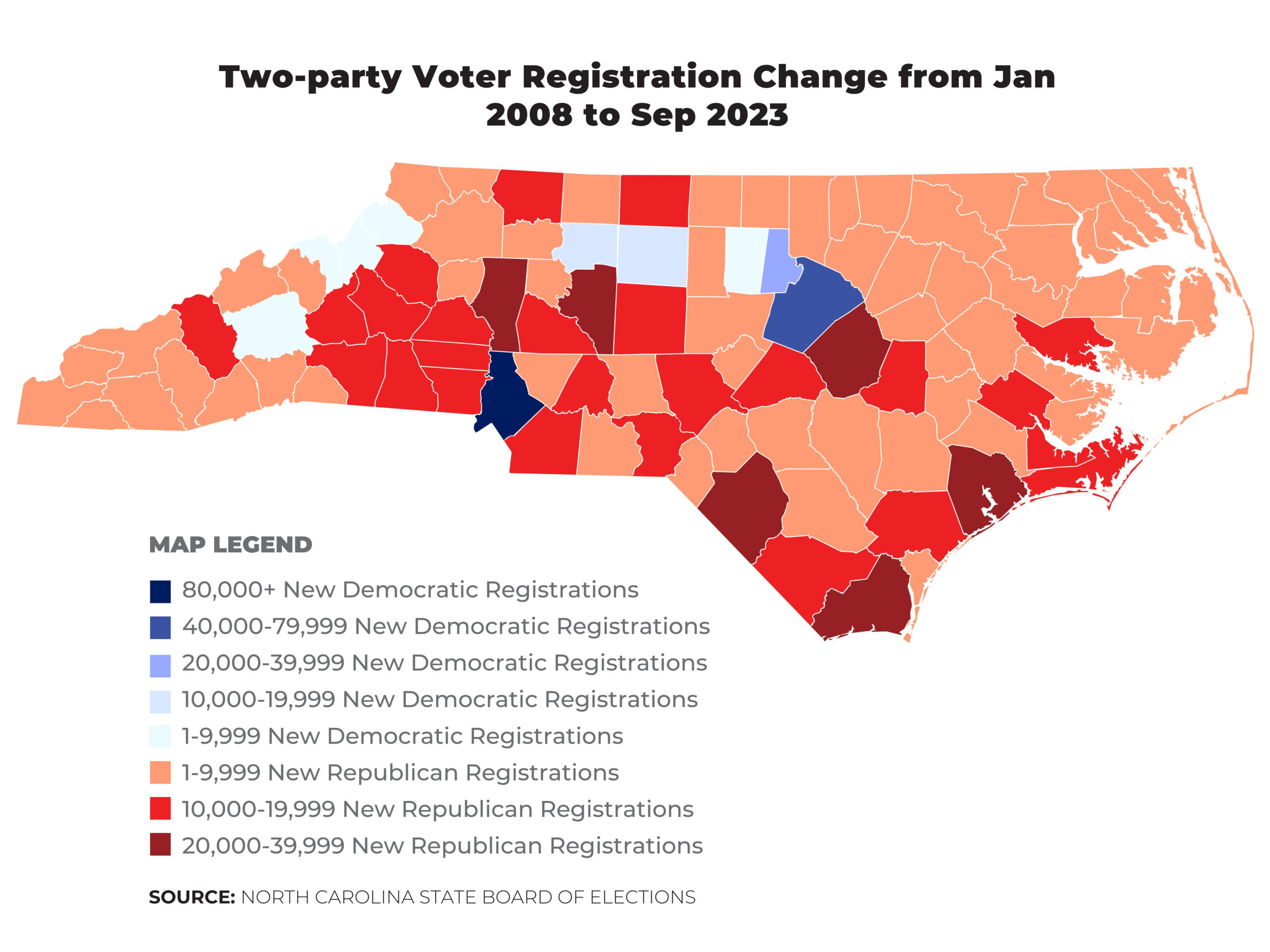
- North Carolina’s voter rolls have grown steadily, increasing from 6.2 million during the 2008 election to 7.8 million in 2024.
- Legislation passed in 2024 moved appointment power for the SBE from the governor to the state auditor
- The SBE’s post-election sample hand‑to‑eye count (audit) recounts two sample units (which can either be precincts, early voting sites, or all the county’s absentee ballots) from each county. Requiring the same limited number of sample units from each county, regardless of the size of the county, makes it less likely that larger counties will include absentee ballots in their samples for recounting.
- After the latest round of election equipment purchases ahead of the 2020 elections, the number of county boards of elections using BMDs for nondisabled voters decreased from 22 to 11. All other counties are using hand-marked paper ballots.
- An experiment on ballot-marking devices in 2020 found that very few voters noticed when the machines made errors in marking their ballots. Researchers at the University of Michigan programmed the machines intentionally to mark ballots differently from the choices voters made on the touchscreen. They found that only 6.6 percent of voters in the experiment noticed and reported the errors.
Recommendations
1. Join a multistate data-sharing program if it does not jeopardize privacy.
Joining such a data-sharing program would improve list maintenance in North Carolina. ERIC is currently the only multistate data-sharing program in operation. North Carolina should reconsider joining ERIC if that organization reforms its data-sharing practices and North Carolina passes a law protecting the privacy of those not registered to vote.
2. Broaden the scope of post-election audits and have them conducted by an independent body.
Have the Office of the State Auditor conduct performance audits of voter registration, election operations, and the paper trail of voter intent for the entire two-year election period (what some call a “forensic audit”).
3. Allocate units in post-election sample hand-to-eye recounts by county size.
More fairly apportion the number of units in the post-election sample hand-to-eye recount according to the number of units in each county (with every county having at least one, per law). Consider using risk-limiting audits, recounts of a randomly selected sample of ballots (rather than a sample of units), once all counties shift to hand-marked paper ballots.
4. Use only hand-marked paper ballots (with touchscreen options for disabled people).
Hand-marked paper ballots cannot be hacked or misprogrammed. With ballots incorrectly marked by touchscreen ballot-marking devices, election officials cannot be sure if the voter or the machine made a mistake on the ballot.