July 9, 2026
RALEIGH — The John Locke Foundation is proud to announce our new county-by-county Energy Poverty Index, a measure of the electricity cost burden facing North Carolina’s most vulnerable households.
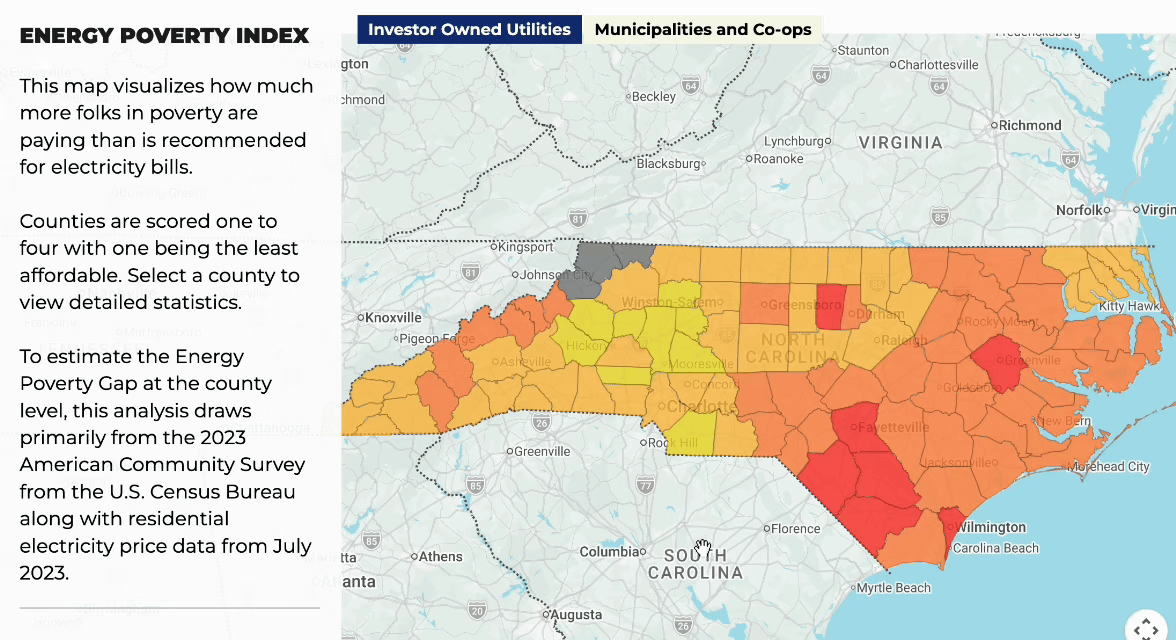
Co-authored by policy analyst Kelly Lester and Jon Sanders, director of Locke’s Center for Food, Power, and Life, the report measures the “energy poverty gap” — how far electricity costs for households in poverty exceed the affordability threshold.
The report separately analyzed counties’ energy poverty gaps for households served either by investor-owned utilities (such as Duke Energy) or by municipal utilities and electric membership corporations. In the report’s investor-owned utility ranking, 49 counties fell into the two most severe energy poverty categories, including seven Level 1 counties, the index’s highest severity level. In the municipal utility and electric membership corporation ranking, 61 counties fell into the two most severe categories, including 27 Level 1 counties.
Least Affordable Counties
(Investor-owned Utilities)
- Pitt
- Cumberland
- Orange
- New Hanover
- Bladen
- Columbus
- Robeson
- Halifax
- Warren
- Hoke
Least Affordable Counties
(Co-Ops & Municipal-owned Utilities)
- Orange
- Hertford
- Halifax
- Northampton
- Transylvania
- Hyde
- Pamlico
- Washington
- Madison
- Durham
“Affordable, reliable energy powers households, businesses, and local economies,” said Sanders. “When families are forced to spend too much of their income on electricity, they have less money for groceries, housing, bills, transportation, and other necessities. Those burdens affect families directly and ultimately weaken our state’s economy.”
The report comes as North Carolina policymakers continue debating energy policy. Last year, the General Assembly enacted the Power Bill Reduction Act (SB 266). This year, the legislature is considering the Rate Payer Protection Act (HB 1002).
“Affordable power is a necessity for families across North Carolina. This report shows that rising power costs fall hardest on households already struggling to make ends meet, and it gives policymakers a county-by-county picture of where that burden is most severe,” said Donald Bryson, president and CEO of the John Locke Foundation. “Lawmakers should begin with a simple commitment: keep the lights on and keep power bills as affordable as possible.”
The report concludes with six policy solutions to address the affordability of electricity in North Carolina:
- Repeal the Carbon Plan Law
- Pass Baseload-for-Baseload Legislation
- Require the NC Utilities Commission to Compare the All-In Costs of New Power Plants
- Pass an “Only Pay for What You Get” Act
- Repeal the Clean Energy and Energy Efficiency Portfolio Standards
- Pass Consumer-Regulated Electricity Legislation
The index builds upon our Center for Food, Power, and Life’s recent energy-policy work, including our 2025 report “Power Plays” examining energy regulation and our 2024 report, “Lighting the Path,” ensuring reliable, affordable energy under the Carbon Plan.

