Introduction
Over the past decade and a half, North Carolina’s regulatory environment has improved steadily. Under Republican leadership, the General Assembly has passed Regulatory Reform Acts regularly since 2011. They have been a mix of some major reforms and handfuls of smaller adjustments to hundreds of regulated areas across the state’s economy. Still, plenty of work remains.
Regulation drags down the state’s economy, keeping it from growing as fast as it should by hindering it with bureaucratic red tape and unwieldly, sometimes even outdated bureaucratic rules. Research consistently shows that freer industries grow much faster and produce at much greater rates than heavily regulated industries.
Cutting fussy administrative rules and keeping regulatory burdens light and up to date are important for economic growth — which means personal income growth, too.
Key Facts
- The 2025 edition of the Competitive Enterprise Institute’s annual study of federal regulations, “Ten Thousand Commandments,” estimated that compliance with federal regulations and their economic effects cost the U.S. economy well over $2 trillion annually.
- A 2015 study by economists with the Beacon Hill Institute at Suffolk University estimated that state regulations cost North Carolina’s economy as much as $25.5 billion in a year.
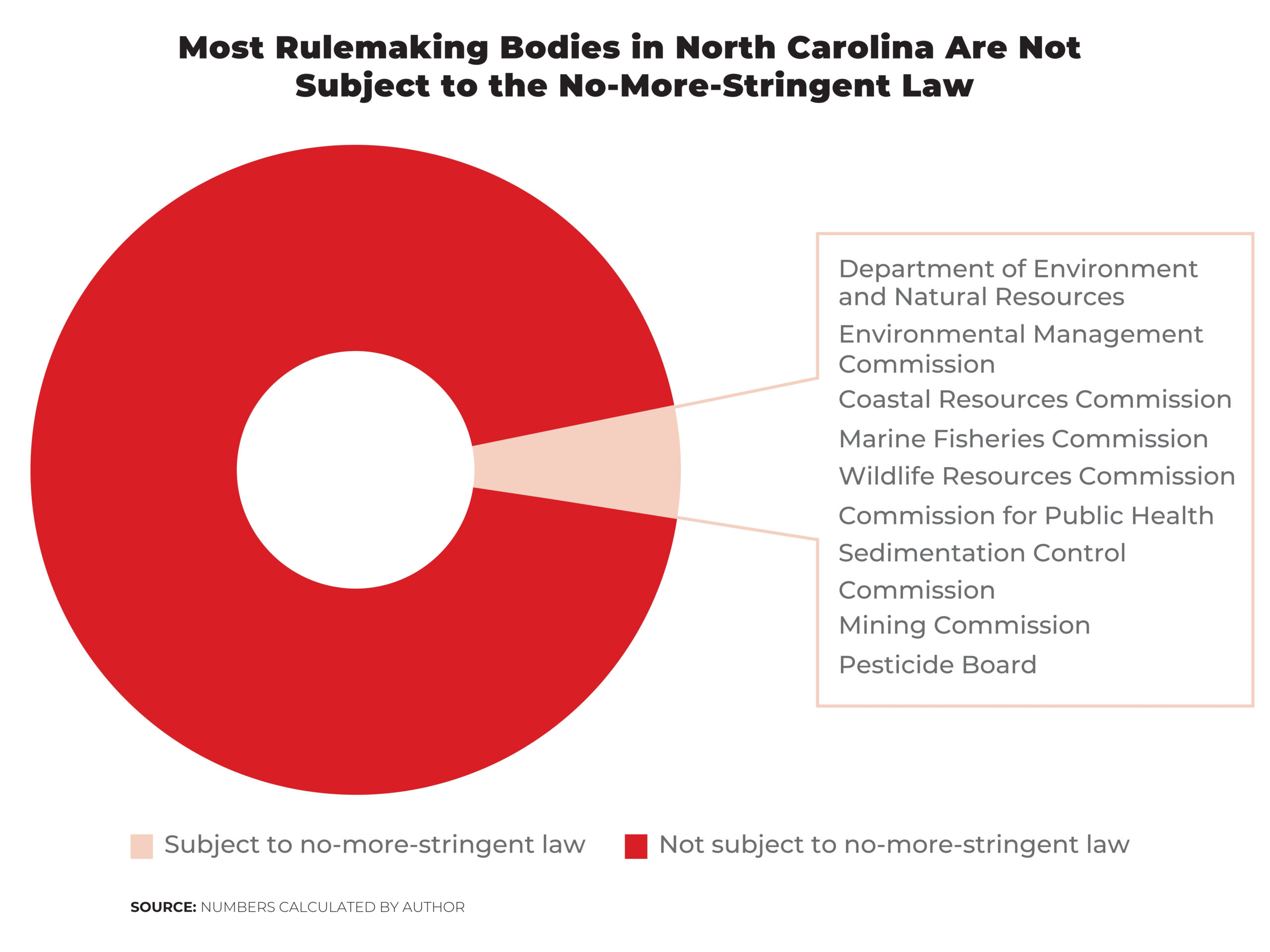
- In 2011, the General Assembly passed a no-more-stringent law to prevent state environmental agencies from unilaterally imposing stricter regulations on North Carolinians than those already imposed by the federal government. The importance of this reform in preventing harmful rulemaking was made clear in 2022 when Gov. Roy Cooper, as part of his agreement with California Gov. Gavin Newsom, wanted California’s environmental rules applied to North Carolina’s cars, trucks, and buses. To accomplish this, he tried to go around the no-more-stringent law by using the North Carolina Department of Transportation, which is not affected by the law. The General Assembly blocked Cooper’s gambit in 2023
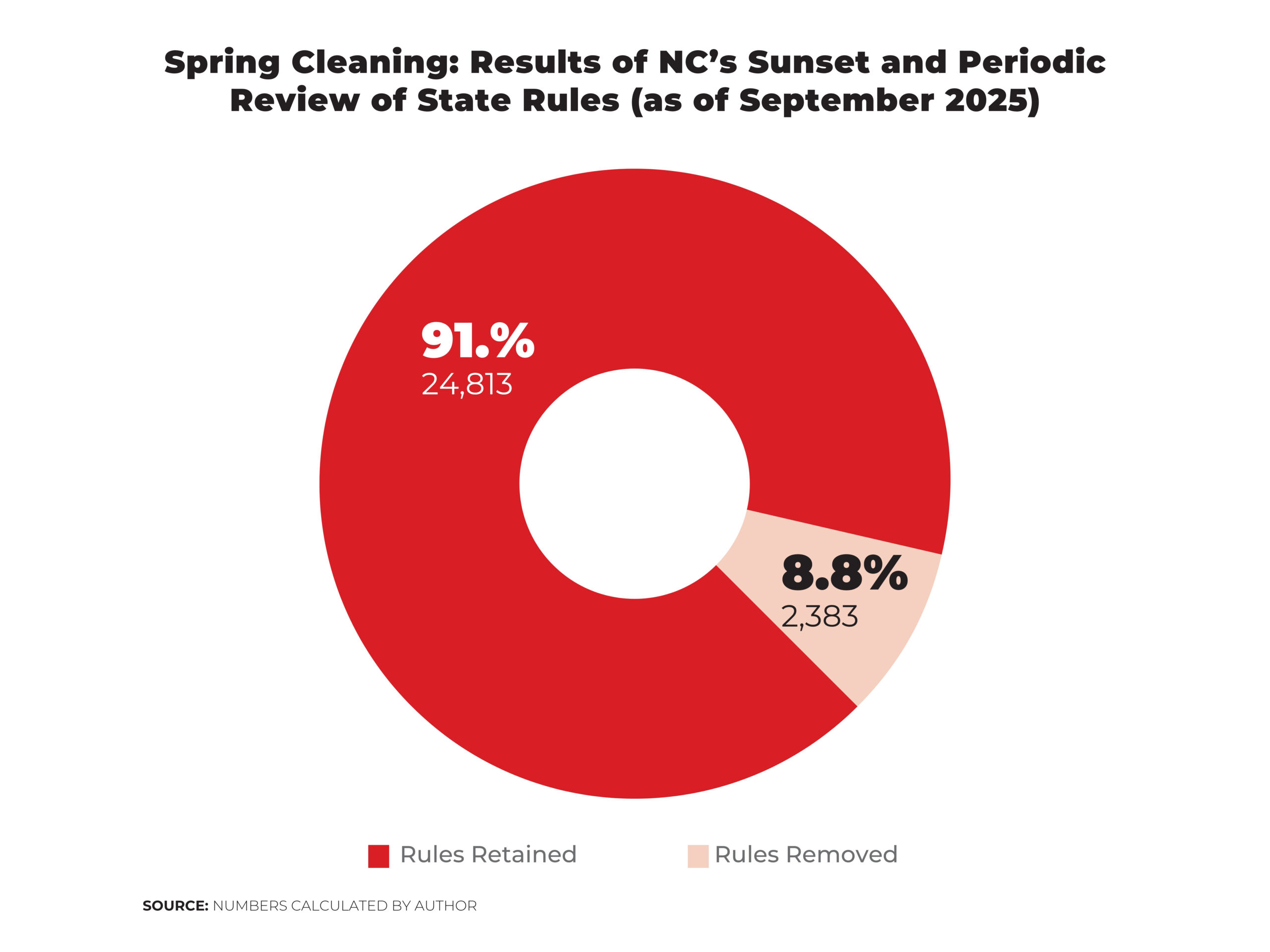
- In 2013, the General Assembly enacted a significant reform for administrative rules: sunset provisions with periodic review. If an administrative rule isn’t reviewed by the agency that created it within a set time period (currently 10 years), the rule is automatically repealed. The review itself may result in the agency deciding to repeal it. The first round of reviews in 2018 removed more than one out of every 10 state rules examined. As of 2025, the review process has culled about one out of every 11 state rules up for review.
- Ten years between reviews is very lengthy, however, and the state’s rulemaking is ongoing. As of 2024, according to the Mercatus Center at George Mason University, North Carolina had more than 109,000 regulatory restrictions.
- Most recently, in 2025, the General Assembly passed — over Gov. Josh Stein’s veto — a law instituting legislative ratification for “rules with substantial financial costs” on the private sector. Legislative rules ratification is a measure that has been working well in Florida since 2010. North Carolina’s law requires the legislature to approve any administrative rule that has an estimated economic impact exceeding $20 million over five years before that rule can take effect. The $20 million threshold is very high, however; Florida’s five-year standard is $1 million.
- For a rule that would exceed $1 million over five years, the North Carolina law requires a two-thirds majority of agency members to have voted in favor of it. If it would exceed $10 million, the required vote must be unanimous.
- State agencies craft rules under authority delegated by the legislature to interpret and implement laws, but sometimes those rules cost the state’s private sector dearly, costs the legislature did not anticipate and would not have approved when delegating this authority to the agencies. Legislative rule ratification is a proven, effective way to ensure legislative scrutiny of any rule whose costs exceed a defined high-cost amount.
- Legislative ratification upholds the separation of powers, making sure a bureaucrat’s costly rule won’t take effect if it isn’t debated and okayed by legislators accountable to the people.
- There is a stealthy kind of regulation known as “regulatory dark matter.” It includes policies, guidelines, memos, and other kinds of interpretive statements coming from administrative agencies that take the place of administrative rules. In effect, they fulfill the official state definition of a rule despite never being formally adopted as rules. All such regulatory dark matter violates the state’s Administrative Procedures Act.
- In 2021, the General Assembly created a regulatory sandbox for the finance and insurance industries. Because regulation tends to protect the “old ways” and prevent new ideas, a regulatory sandbox provides a less-restrictive regulatory environment for testing innovative new products and services for a limited period of time.
- From 2020 to 2021, Gov. Roy Cooper’s various executive orders shut down untold numbers of businesses statewide over Covid-19 and also greatly restricted their normal business operations. Those orders amounted to a regulatory taking, the effects of which are not unlike an eminent domain taking — government depriving people of the use of their property ostensibly for a public purpose. As with eminent domain takings, North Carolina law should have clear and fair guidelines for compensating business and property owners victimized by regulatory takings such as executive shutdown orders.
- North Carolina is one of only six states without small-business regulatory flexibility to let agencies make common-sense adjustments to small businesses’ regulatory burdens, such as compliance and reporting requirements.
- Several other reforms would help free North Carolina of unnecessary red tape. For example, states have reduced their total stock of rules using regulatory budgeting (to adopt a new rule, an agency must retire a certain number of old rules) and dedicated efforts such as Red-Tape Reduction Commissions. Having stated objectives and outcome measures would help ensure that rules function as intended. Implementing strong cost/benefit analysis would help agencies make better choices.
Recommendations
1. Apply the no-more-stringent law to all state agencies, departments, divisions, etc.
If North Carolina must have a stricter regulatory environment for something, then let it be passed by normal lawmaking rather than imposed by unelected, unaccountable bureaucrats.
2. Shorten periodic review of rules to every five years and require stated objectives and outcome measures for rules.
Agencies should always scrutinize and look to remove unnecessary and outdated rules, including those that fail to achieve their original purposes.
3. Lower the cost considered substantial enough to trigger legislative ratification of a proposed rule.
The current threshold is $20 million or more over five years, which is 20 times more lenient than Florida’s standard of $1 million over that same period. An administrative rule should not be nearly that disruptive to a state’s economy, however. If it would be, then it would serve the people of North Carolina better for their elected representatives tasked with lawmaking authority to make sure the rule conforms to their intent for delegating some of their authority to an agency.
4. Have all agencies identify and either repeal or codify all regulatory dark matter.
Policies, guidelines, memos, other interpretive statements, etc. that actually function as rules according to the official state definition of a rule are regulations in violation of the state Administrative Procedures Act.
5. Create clear and fair guidelines for compensating business and property owners victimized by regulatory takings.
When business owners are deprived of the use of their property by government ostensibly for a public purpose, including fighting a virus, they should be compensated as a matter of law.
6. Enact Regulatory Budgeting, a Red-Tape Reduction Committee, Small-Business Flexibility Analysis, Strong Cost/Benefit Analysis, and Removal of “Orphan Rules.”
These reforms would all further the goal of having good, common-sense rules only when needed and without unnecessarily hamstringing the economy.